

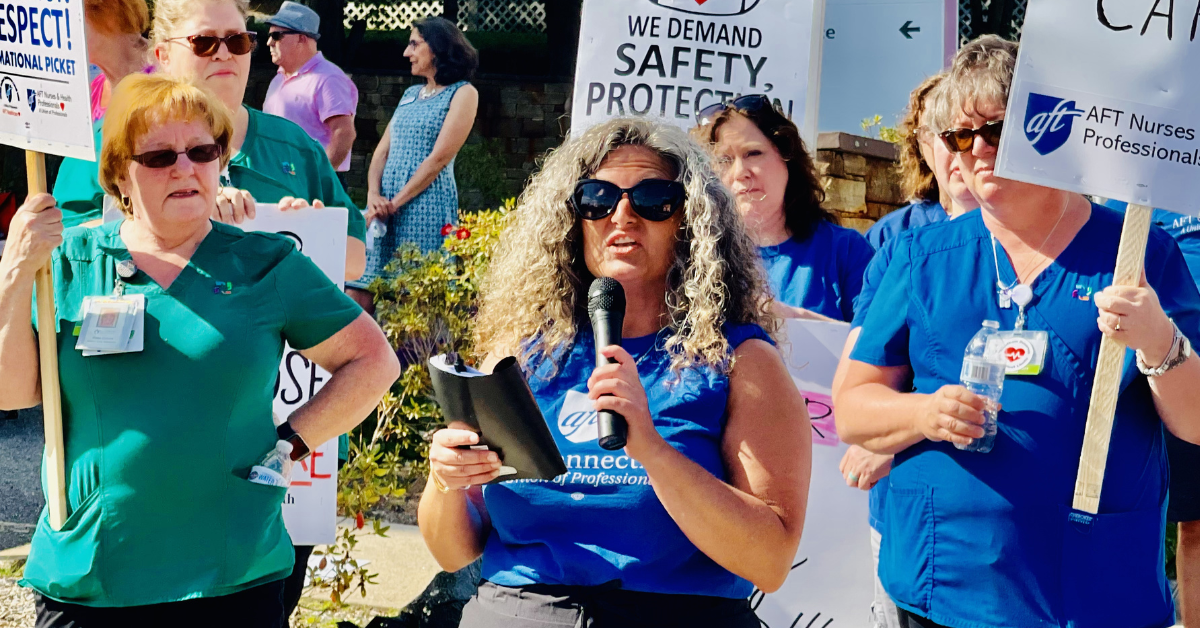
The excessive compensation doled out to the chiefs of the state’s largest non-profit health networks underscores the industry’s chronic disinvestment in direct clinical caregivers and support personnel. Andrea Riley, RN (speaking in photo, above), called out the two worst offenders in a recently published op-ed. The president of our AFT Connecticut-affiliated Windham Hospital Federation of Professional Nurses urged redirecting patient care dollars to “the people working at the bedside in our community:”
It would take a nurse nearly 60 years to earn what the CEOs of Hartford HealthCare (HHC) and Yale New Haven Health Systems (YNHHS) banked just last year. Let that sink in.
When faced with a staffing crisis that threatens the operations of every healthcare facility in the country, and despite recent messaging on the financial stress facing Connecticut’s hospitals, two of our state’s largest nonprofit health networks opted to give their top executives significant pay hikes instead of working to recruit, retain, and reinvest in their workforce.
A recent article noted that HHC CEO Jeffrey Flaks – who is not a licensed practitioner – saw a 22.2% increase in his total compensation, taking in over $5 million in FY 2025. Meanwhile, YNHHS CEO Christopher O’Connor – also, not a licensed caregiver – received over $6 million in 2025, a 22.1% increase over the previous year. For context, a registered nurse working in Connecticut makes, on average, about $40.02 an hour. This comparison doesn’t even scratch the surface of wage disparities across the many other job titles among hospital staff.
Yet services to communities continue to be cut, as has been the case at Windham Community Memorial Hospital (WCMH), the Hartford HealthCare-owned facility where I’ve invested my career in bedside care. Since the network’s take-over in 2008, devastating cuts have been made to our Intensive Care Unit (ICU) and Labor & Delivery departments. Clinical personnel have been laid off and many departments continue to work chronically short-staffed.
Surprisingly, these executives’ lavish raises don’t seem to be tied to the financial security of the systems they oversee. According to the article, YNHHS reported nearly $200 million in operating losses for the fiscal year 2025.
If hospital administrators truly believe that these CEO raises “enable us to continue attracting and maintaining a world-renowned executive leadership team,” then why do they not apply that same principle to the bedside staff actually performing life-saving work?
A Yale spokesperson explains that compensation of YNHHS senior leaders is set by their Board of Trustees. It should be further pointed out that hospital boards are not publicly elected, as is the case with boards of education or town councils. Nonprofit hospital boards are often self-perpetuating; when there are openings, the current board members typically hand-pick the replacement. Yet, like boards of education and town councils, hospitals are predominantly financed with public dollars, through Medicare, Medicaid and patients’ insurance premiums.
It is not uncommon for senior executives to serve on multiple boards. For instance, the Connecticut Hospital Association (CHA) executive committee comprises several HHC and Yale senior executives. To be clear, that’s four of its nine executive committee members and six of its 12 trustee seats. In fact, Flaks is Vice Chair and O’Connor is the Immediate Past Chair.
CHA claims that “top-tier talent, as challenges grow, is fundamental to protecting patient care, workforce stability, and access to essential services.” We can actually agree on this, but the members of our union believe the emphasis should be placed on the people working at the bedside in our community, not the senior executives in their boardrooms.