

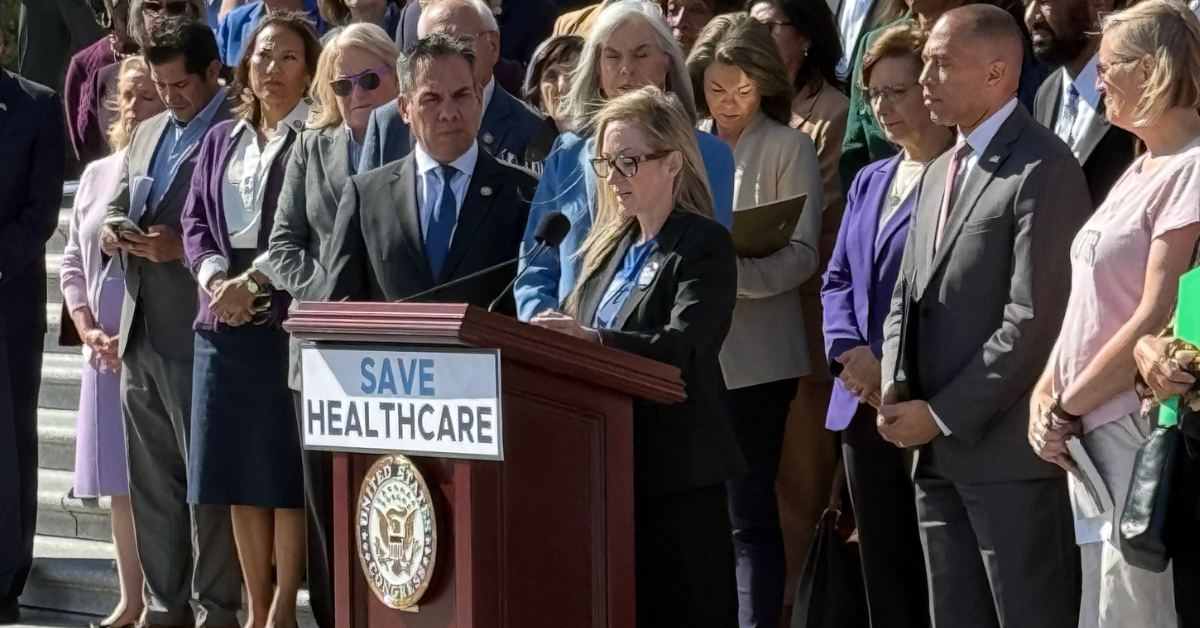
The shutdown of the federal government this fall was largely due to the failure of the White House and the majority party in Congress to address a looming healthcare crisis. Before the stalemate ended, Heather Brauth, RN (at podium, in photo, above) demanded action at the U.S. Capitol and in a recently published op-ed. The president of our AFT Connecticut-affiliated Backus Federation of Nurses sounded the alarm for her patients, warning elected officials that prolonged neglect means that “some will die:”
As a surgical nurse at a small hospital in Norwich, I work hard to give my patients the best possible care because that’s what they deserve.
That’s hard enough to do with a health care system that’s as strained as it is now. My fear is that it will become much worse. That’s why I traveled to Washington, D.C., recently to speak at a news conference and hearing with House Democrats.
A health care crisis is just around the corner because of the so-called One Big Beautiful Bill Act, an ugly law enacted by Republicans in Congress and the Trump White House last summer. This partisan law slashed Medicaid and allowed the Affordable Care Act healthcare tax credits to expire for working families — all while funding tax breaks for billionaires.
That’s great if you have money. But it’s going to make life harder and more expensive for everyone else, including more than 100,000 people in Connecticut who will face higher premiums if the tax credits expire.
Already, our small community hospital has had one of the busiest years to date. And with cold and flu season ahead, healthcare workers are gearing up for the worst respiratory virus season we have seen since COVID-19 in 2020.
We have a nursing shortage. It currently takes months to see primary care providers, and forget about getting an appointment with a specialist in under six to 12 months. We have patients sleeping overnight on stretchers in our emergency rooms and waiting on stretchers in hallways for other patients to be discharged.
It’s clear that the cuts coming down the pike have the capacity to dismantle and destabilize our currently understaffed and struggling healthcare system. Hospitals and clinics will close or cut essential services, forcing patients to travel farther and wait longer for care. Up to 15 million people could eventually lose their healthcare coverage, and millions more will see their healthcare premiums increase.
People can’t afford groceries right now. How do we expect them to afford significant rate increases to their health insurance?
And we know that rural communities will face higher premium increases than other communities if the healthcare tax credits are allowed to expire. Nationally, nearly a quarter of farmers and ranchers get healthcare coverage through plans supported by these tax credits. Entire communities will be devastated if the politicians in charge of Congress and the White House don’t take action.
The frontline health care workers are scared. Anyone who is concerned about their own health or a loved one’s health should be as well.
Asking our friends and neighbors who can’t afford food or rent to pay, on average, more than double for their health insurance premiums is going to force people off their health insurance. And that won’t stop people from needing emergency care, regardless of whether they live in a blue or a red community. Communities will suffer. People will get sicker. It’s not at all a stretch to say that some will die.
But instead of working with Democrats to lower health care costs, Republicans shut down the government and took a vacation. Many of our patients are hardworking Americans who are about to receive notice that they are losing the tax credit that allows them to afford health care — and Republicans are OK with that.
Republicans control Congress and the White House. They should return to D.C. and do their jobs. They should end this government shutdown and work with Democrats to rescue the healthcare that’s now at risk. Our patients and communities deserve no less.
Editor’s note: The federal government funding agreement signed into law on November 12 did not resolve the issue of expiring Affordable Care Act (ACA) premium subsidies; photo credit to Nicole Guadiano, AFT.