

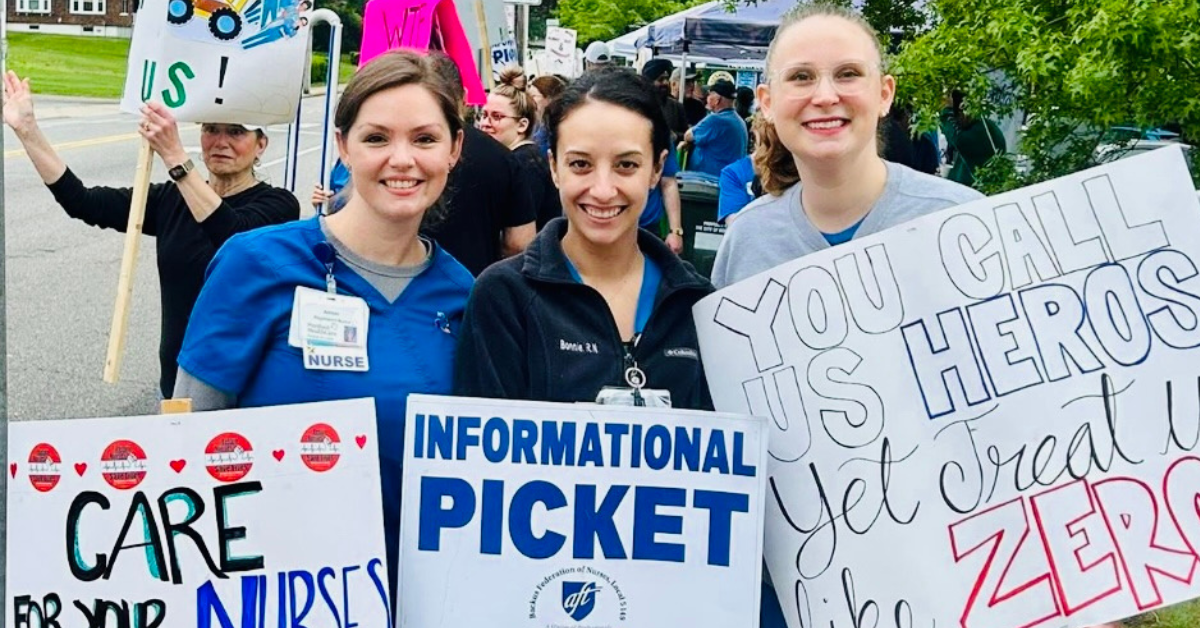
After surviving a harrowing bedside assault that left her with lasting physical and emotional scars, a courageous healthcare union member is refusing to remain silent. Amber DeSouza (left, in photo, above), a conventional delegate for our AFT Connecticut-affiliated Backus Federation of Nurses, is transforming a personal trauma into a powerful demand for employers to implement standardized violence prevention. In a recent blog post for our national union’s Medium blog, she shared her story to help bring about real solutions for “a systems failure:”
Amber DeSouza still remembers how steady she felt that night.
After almost two years in nursing, she had learned to trust her instincts. She had admitted this patient days earlier, watched their condition improve, and noted the small setbacks and adjustments that come with being in the hospital. She was working the night shift now – confident, prepared, doing what nurses do: tracking details, reading people, and staying one step ahead.
Before nursing, DeSouza was a mother. She went back to school after having her boys, now 14 and 11. Nursing was her second career, but it had been shaped long before she ever put on scrubs — back when her youngest brother was 17 and fighting T-cell lymphoblastic lymphoma. For months, she watched nurses care for him, and for her family, with a tenderness she never forgot. When he died, the dedication of nurses stayed with her. Years later, those memories pulled her into the profession.
She wanted to be that person for someone else.
A routine moment, and then it wasn’t
At the start of her shift at William W. Backus Hospital in Norwich, nothing felt unusual. The day shift nurse mentioned her patient had grown more agitated – restless, pulling at lines, frustrated about being in bed. A sitter had been placed in the room to keep things safe. During the safety sweep, everything checked out. The patient answered orientation questions correctly and a family member sat quietly nearby.
DeSouza moved on to see her other patients.
Then she heard raised voices from the room next door. The patient was trying to get out of bed. DeSouza stepped back inside, reintroduced herself, asked orientation questions again. The answers were clear. The patient wasn’t confused – just frustrated.
DeSouza asked two patient care techs standing outside the room to help reposition the patient, to make them more comfortable. It was a routine moment, one that nurses navigate every day.
And then it wasn’t. The patient started swinging, and DeSouza reacted instantly. She told the patient care techs to step back, this wasn’t safe – for them or for anyone. She called for help and turned toward the family member, explaining what needed to happen next. She took a step closer to the foot of the bed. The kick came fast. The patient lifted their leg and drove their heel into DeSouza’s chest. The kick landed beneath her left breast and launched her backward. She slammed into the sitter behind her. If the sitter hadn’t been there, DeSouza would have hit the floor.
“I remember seeing stars,” she says. “I couldn’t breathe.”
Everyone in the room froze. DeSouza instinctively wrapped her arms around her ribs, trying to protect herself, trying to pull air into her lungs. Even then, her first thought was the patient — making sure they were safe. But the pain was too much.
She left the room. The charge nurse took over, and DeSouza headed to the emergency room. In the ER, scans revealed a chest wall contusion, a bruised sternum, and a probable rib fracture. She went home believing she would heal. Three months later, she is still healing from nerve pain, spasms between her ribs and pain that radiates through her breast tissue.
Simple things – lifting, bending, twisting – are off limits. She’s back at work, not at the bedside, but on desk duty. It’s a role that feels foreign to someone who became a nurse to be hands-on.
At home, everything has shifted. Her children worry when she leaves for work. She worries about them worrying.
Emotionally, the weight of the incident lingers. The hospital offered five counseling sessions and because she already had a therapist, she continues the counseling. Trauma doesn’t disappear just because your shift ends.
“You leave your family to take care of other people’s families,” DeSouza says. “You never expect to be hurt doing that.”
And yet, she keeps coming back.
She helps new nurses. She answers questions. When she notices warning signs others might miss, she speaks up, because she knows what happens when nurses are left alone in escalating situations.
Since the incident, the hospital has implemented what it calls an “agitation huddle,” meant to be initiated when a patient begins to escalate. In DeSouza’s case, when she contacted her charge nurse and security was called, that response would technically qualify.
What continues to trouble her is what comes before that moment. DeSouza thinks about how hospitals prepare for emergencies – like how sepsis triggers automatic protocols, staffing, and resources. She wonders why violence is treated differently. Why there isn’t a standard in place when agitation builds, when warning signs appear, when a nurse needs backup before something goes wrong.
“We have sepsis bundles,” DeSouza says. “When a patient becomes septic, there are automatic orders and clear pathways. Nurses don’t have to stop and ask.”
With agitation and violence, that standard structure doesn’t exist, she says,. There are no standing protocols embedded in the chart – no pre-ordered support, no automatic escalation, no built-in authority to act early. Nurses are left managing risk in real time, often while caring for multiple patients.
The agitation huddle is one of the improvements DeSouza’s union, the Backus Federation of Nurses, has urged management to make through its workplace violence prevention committee. Union members insisted on union representation on the committee and a genuine effort to address rising violence in the facility. “Getting management to take the problem seriously, invest in prevention, and work with us is hard, but we are making some progress,” she says.
DeSouza views this not only as someone who was injured but also as her unit’s representative for the hospital’s professional governance and a member of the workplace violence committee.
“This isn’t just personal,” she says. “It’s a systems failure – and it’s preventable.”
One of the hardest decisions ever
The incident led to one of the hardest decisions she’s ever made: whether to press charges. When a security guard first asked her, she couldn’t answer. How do you hold a patient accountable – someone you’re trained to protect? She replayed the incident over and over. At first, she couldn’t imagine it. The patient had been under her care. Nurses are trained to understand vulnerability, illness and fear. How do you hold someone accountable when your job is to protect them?
But the details wouldn’t leave her. The patient had been oriented, apologetic and aware. And the security guard offered a comparison she hadn’t considered: when a police officer or EMT is assaulted, circumstances don’t erase accountability. Why should nurses be different?
“If I don’t say anything,” says DeSouza, “it’s the next nurse. The next patient care tech.”
She pressed charges but remains conflicted, still carrying the weight of that decision.
What steadied her was her union. The union leadership guided her through workers’ compensation, medical care, and the maze of expectations that followed. The hospital’s first official email explaining how to access occupational health arrived two weeks after the assault. Two weeks of uncertainty. Two weeks of unanswered questions.
Instead, DeSouza found herself retelling the story again and again – to HR, legal, managers, doctors, insurance. Each retelling reopened the wound.
“There has to be a better way,” she says. “And I say that because if it weren’t for my union, I would have been totally lost in what was expected of me. Through the solidarity of our union, I found the support I needed.”
DeSouza didn’t choose nursing because it was safe or easy. She chose it because she believes in care – deeply, stubbornly, even now. But she also believes compassion should never require silence, and care should never come at the cost of a caregiver’s safety.
She still shows up. But she’s no longer quiet about what needs to change. DeSouza is clear about what needs to change: zero tolerance for violence, standardized support for injured healthcare workers, clear communication, and systems that protect caregivers as fiercely as they protect patients.
“There should be a standard of care for healthcare workers,” she says. “End of story.”
Editor’s note: original post by Adrienne Coles, AFT.