Union leaders, school officials, and administrators are sounding a collective alarm: state and federal cuts are pushing public education to the brink. Late last month, members of AFT Connecticut affiliates gathered in Hartford for the 2026 CT Education Issues Summit to demand the investment and protections our students and educators deserve.
The January 28 event was co-organized with the Connecticut Education Association (CEA) and advocacy partners in the Connecticut Association Boards of Education (CABE) and the Connecticut Association of Public School Superintendents (CAPSS). The purpose was to elevate real solutions for a workforce under strain and a looming funding crisis.
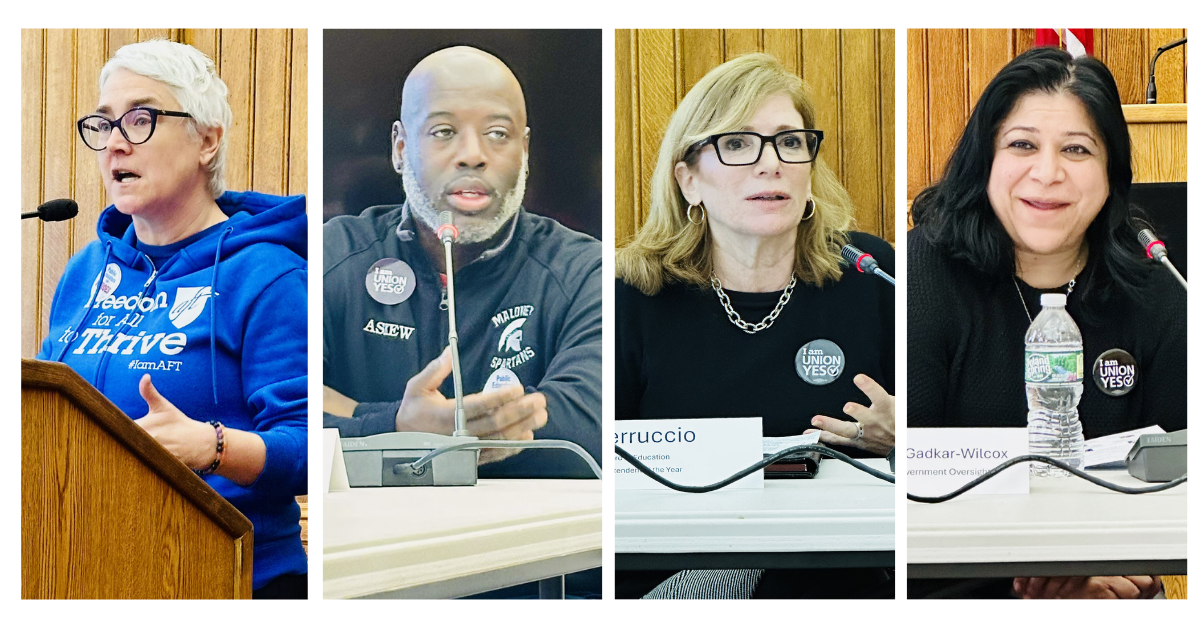
“Educators and support personnel are being asked to do more with less at a time when students need more than ever,” said AFT Connecticut Vice President for PreK-12 Leslie Blatteau (left, in collage, above). “Chronic disinvestment and political attacks from Washington have pushed schools to a breaking point. We are demanding that leaders act now to protect our kids and communities.”
The Workforce Crisis
The day opened with a deep dive into the recruitment and retention crisis. Panels featuring PSRP and higher education members highlighted how stagnant compensation and top-down mandates are driving talented professionals out of the classroom.
Don Akew (second from left, above), Meriden Federation of Paraprofessionals member, said, “you have to decide if you’re going to do something you love, like working with kids, because that doesn’t pay the bills. Especially new paras are forced to decide if they’re gonna stick around. I’ve seen many great paras just bow out after a year because they couldn’t figure out how to make things work.”
Jan Perruccio (second from right, above), CSU-AAUP member, added, “once we get people in the profession, give them a seat at the table. Constantly having top-down mandates really begins to erode educators’ feelings that they are important. Sometimes they find themselves doing things in the classroom that don’t make sense for their children.”
Defending the Freedom to Teach
The conversation shifted to the increasing politicization of the classroom. Former U.S. Education Secretary Miguel Cardona shared national insights, followed by a discussion on the importance of maintaining job protections against censorship and “cancel culture.”
“We should always have encouraged more debate, dialogue and dissenting opinion,” said Quinnipiac AAUP member Sujata Gadkar-Wilcox (right, above). “Maybe we shouldn’t have been so quick to ‘cancel’ and dismiss controversial speakers. There has to be a place for figuring out how we can allow controversy to have a space for dialogue.”
The Privatization Threat
A “working lunch” moderated by AFT Connecticut President Jan Hochadel featured national AFT President Randi Weingarten, U.S. Rep. Jahana Hayes, and author Josh Cowen. The panel focused on the dangers of the federal “One, Big Beautiful Bill Act” and the expansion of tax credits that drain resources from public schools.
Josh Cowen described voucher schemes as a bait-and-switch for families.
“Why I call vouchers education’s version of predatory lending is that it gives parents this false hope that everybody’s gonna go to the Hotchkiss School,” he said. But, in fact, you take the coupon, and there’s no ‘room at the inn’ for you. That’s the most dangerous and insidious part of this.”
The Path Forward
The summit concluded with a unified mandate: lawmakers must prioritize public education investment and safeguard the profession before further damage is done. Our members remain committed to leading this charge in the legislature and in our communities.
Editor’s note: includes contributions by Lesia Day, CEA.